
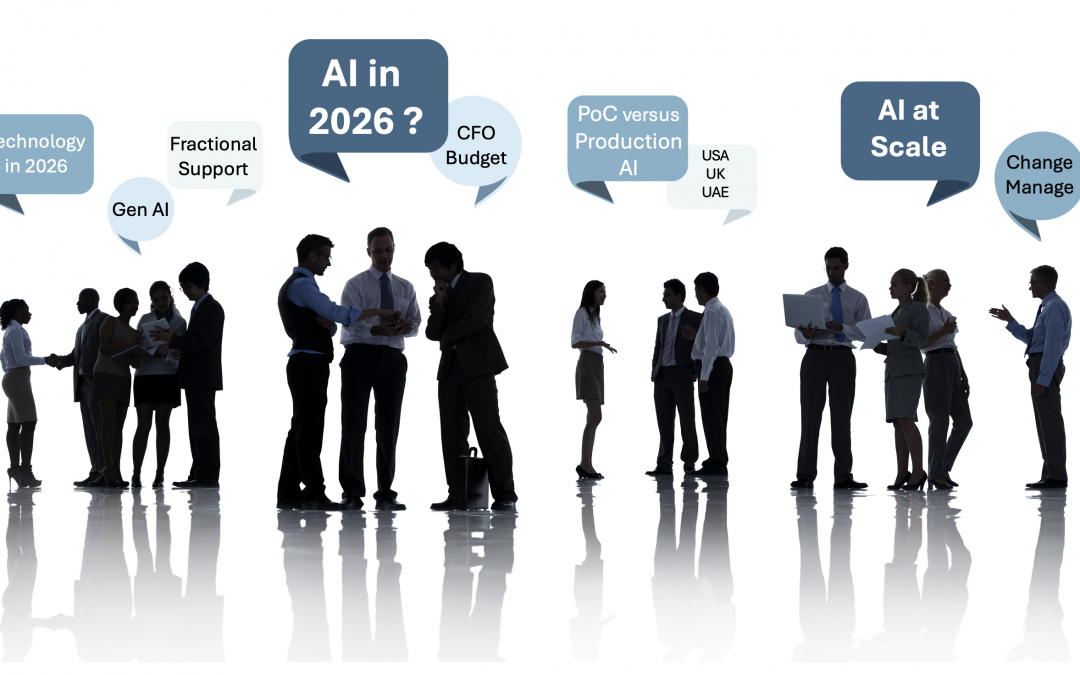
2026 Is Going to be The Year When CFOs Stop Nodding at Your Transformation Plans, Looking for PoCs to Become Production.
“We’ve spent 2025 experimenting with AI, testing platforms, and watching everyone else do the same thing.” comments Craig Ashmole, a Fractional CIO, Dubai, UAE. “The hype cycle peaked, the Big-5 consultants circled, some with news worthy questionable deliverables and now we’re left asking: what actually worked?”
The Reality Check
The USA has moved from “AI for AI’s sake” to demanding P&L impact in quarters, not years. Finance teams are done nodding politely at transformation roadmaps. If you can’t articulate which salary expense your AI replaces or which revenue line it grows, you’re not getting budget. The market has spoken: organisations are shifting from experimentation to extracting real business value.
The UK is showing its characteristic caution, but with good reason. The IPO market raised only about £160 million in the first half of 2025, the lowest in at least thirty years. Funding is tight, exits are blocked, and corporate insolvencies remain near multi-decade highs. Yet UK businesses are still investing, averaging around £235,000 on AI and emerging technologies, because standing still isn’t an option. The difference? They’re being surgical about it, not scattergun.
The UAE is playing an entirely different game. The ICT market is projected to grow at 13.4% CAGR through 2035, fuelled by government mandates, sovereign AI investments, and a relentless push toward becoming the regional technology hub. Whilst Western markets are tightening budgets, the UAE is allocating billions for AI-driven government platforms and infrastructure. This isn’t aspiration, it’s execution backed by capital.
What to Tread Carefully With
Agentic AI isn’t ready for primetime in most organisations. Gartner predicts over 40% of agentic AI projects will be cancelled by the end of 2027. The gap between demo and production-ready is vast. Before you commit significant capital, ensure you have the governance frameworks, the data foundations, and frankly, the organisational maturity to supervise autonomous systems. The companies rushing to deploy without proper oversight will face very public failures.
Vendor lock-in is becoming genuinely dangerous. Dependencies on large vendors are creating risks from cyberattacks and outages, and we’ve all seen the cascading failures when a major cloud provider stumbles. The “move fast and lock in” strategy that worked a decade ago is now a board-level risk discussion. Diversification isn’t belt-and-braces anymore, it’s basic resilience.
Supply chain fragility continues to bite. Whether it’s component shortages, geopolitical tensions, or tariff unpredictability, tech supply chains are becoming more expensive, complex, and less predictable. Don’t assume your vendor roadmap is immune to these pressures.
What to Move Fast On
Production AI, not pilot AI. 2026 is the year to pick a few GenAI patterns and make them work at scale. Stop the proof-of-concept carousel. Identify use cases with clear ROI, build proper governance from day one, and actually measure outcomes. The winners in 2027 will be those who used 2026 as serious implementation, not extended exploration.
Small language models are your secret weapon. You don’t need frontier models for most enterprise use cases. Internal search, document summarisation, content workflows: these run faster and cheaper on specialised smaller models. Specialised models can do much of the work at lower cost, with better latency and more predictable behaviour. Stop overpaying for capability you don’t use.
Security infrastructure needs immediate attention. The attack surface has expanded massively with AI adoption, SaaS sprawl, and remote work permanence. EU AI Act requirements for high-risk AI systems come into force by August 2026, and regulatory pressure is only increasing. Get ahead of this. Security is no longer just IT’s problem; it’s an executive accountability issue.
Data governance and model observability are non-negotiable. Boards and compliance teams need visibility into model behaviour, data provenance, and oversight mechanisms. If you can’t explain how your AI makes decisions, you can’t defend it to regulators, customers, or your own audit committee. Build this capability now.
Regional Playbooks
USA: Ruthless prioritisation. Focus on measurable outcomes. Finance-led accountability is the new normal, so align every technology investment to explicit business metrics.
UK: Operational resilience over innovation spectacle. With tighter funding and heightened regulatory scrutiny (DORA, critical third-party regimes), firms must map dependencies, test scenarios, and evidence resilience. Partner with stable, well-capitalised vendors who’ll still be standing when things get choppy.
UAE: Scale with ambition but build governance. The capital is there, the appetite is there, but data-residency clauses in the draft Personal Data Protection Law are steering workloads toward in-country cloud regions. Understand compliance early and architect solutions that can operate within these constraints whilst maintaining global connectivity.
What Actually Works in 2026
“We’re past the ‘let’s try everything’ phase. 2026 is about disciplined execution, demonstrable value, and building foundations that actually scale.” Craig gores on to say, “The technology landscape hasn’t moved forward as dramatically as the headlines suggest.”
What’s moved is our understanding of what actually concerns business and that’s realistic production and not PoC concepts.
This is where having battle-tested expertise makes the difference. Companies that succeed in 2026 won’t be the ones with the biggest consulting teams or the most ambitious slide decks. They’ll be the ones who brought in senior transformation leaders who’ve done this before, who’ve made the mistakes on someone else’s budget, and who know how to cut through the noise.
Fractional leaders with real war stories bring something permanent hires often can’t: they’ve seen multiple transformations, they know where the bodies are buried, and they’re not interested in protecting their position. They’re there to deliver, fast. They’ve navigated vendor negotiations, steered AI implementations past the pilot graveyard, and built governance that actually functions rather than just ticking boxes.
If your technology agenda for 2026 involves words like “transformation,” “AI at scale,” or “operational resilience,” you need people who’ve already fought those battles. Not advisors who’ll run workshops. Not junior managers learning on the job. You need someone who can walk into your first steering committee meeting and say, “I’ve seen this exact problem at three other companies, and what worked was this.”
Stop chasing the next shiny thing. Master what you’ve already committed to. Build governance that’s genuinely fit for purpose, not compliance paperwork. And if you can’t articulate the business case in one sentence, you’re not ready to implement it.
The winners in 2026 will be the ones who executed ruthlessly on a focused few things that genuinely moved the needle. Get the right people in the room, and get on with it.
by Craig Ashmole, Fractional CIO, Straightalking Consultancy, Dubai UAE.
I've lived in the world of Corporate CIOs long enough to know: The biggest challenges are best solved together. That's why I'm sharing my blog as a forum where IT leaders share hard-won lessons and chart the path forward, post-pandemic, post-AI PoC's and ready for what's next as AI takes over the world.
Recent Comments